The Cutest Children’s Bathroom Ideas for Every Age and Style

INTRODUCTION:
A great bathroom makes kids actually want to be in there — and that changes everything about your daily routine. Children’s bathroom ideas don’t have to mean loud primary colors and plastic accessories; the best ones are creative, practical, and beautiful enough for the whole family to love.
I’ve noticed that parents are increasingly looking for designs that feel intentional and elevated while still being genuinely fun and child-friendly and this article delivers exactly that. Whether you’re designing a shared family bathroom, a dedicated kids’ space, or simply refreshing what you already have, these 17 ideas cover every age, every style, and every budget. Get ready to be inspired, save your favorites, and turn bath time into the best part of the day.
1.Underwater Theme Tiles
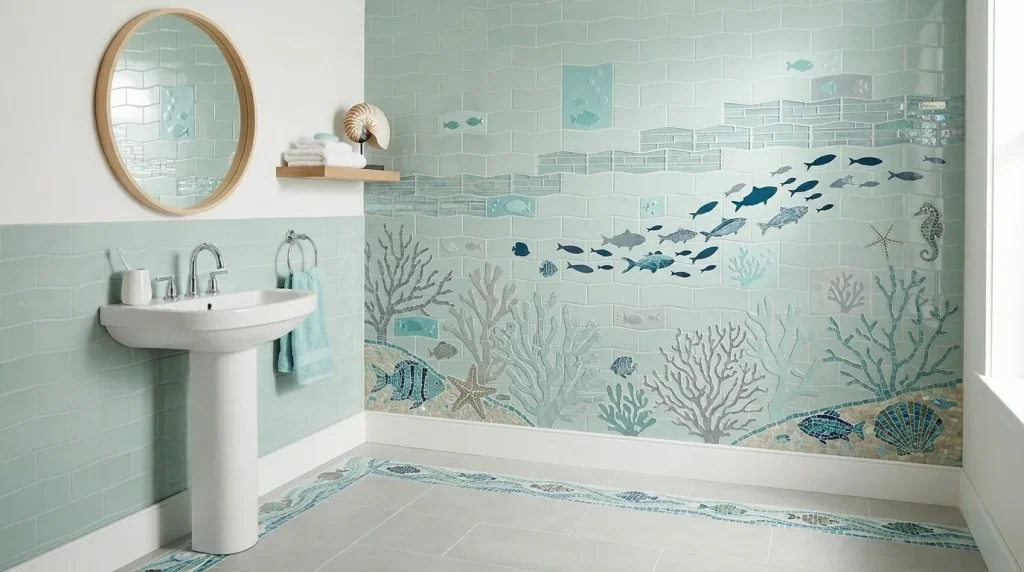
Tiles are the most permanent and highest-impact design decision in any bathroom, and in a children’s space that permanence is actually an advantage when the theme is chosen thoughtfully. An underwater palette in soft seafoam, pale aqua, and warm teal creates a bathroom that feels imaginative and immersive without relying on character licenses or bold primary colors that quickly feel dated. The ocean is a universally loved theme across childhood from toddlers fascinated by fish to older children with a genuine interest in marine biology which means this design has genuine longevity built into its concept from the start.
The beauty of a tiled underwater theme is its layered approach. Rather than covering every wall in a busy pattern, a smart approach uses a solid color tile for the majority of the walls and introduces the decorative detail through a border tile, a mosaic feature strip, or a patterned floor tile. This restraint keeps the room visually balanced and allows the fixtures — sink, mirror, lighting — to remain clean and contemporary. That’s why many designers recommend leading with a simple tile palette in a theme color and adding the character through accessories and smaller details, which can be easily updated as the child grows without retiling the whole room.
2.Step Stool Built-In
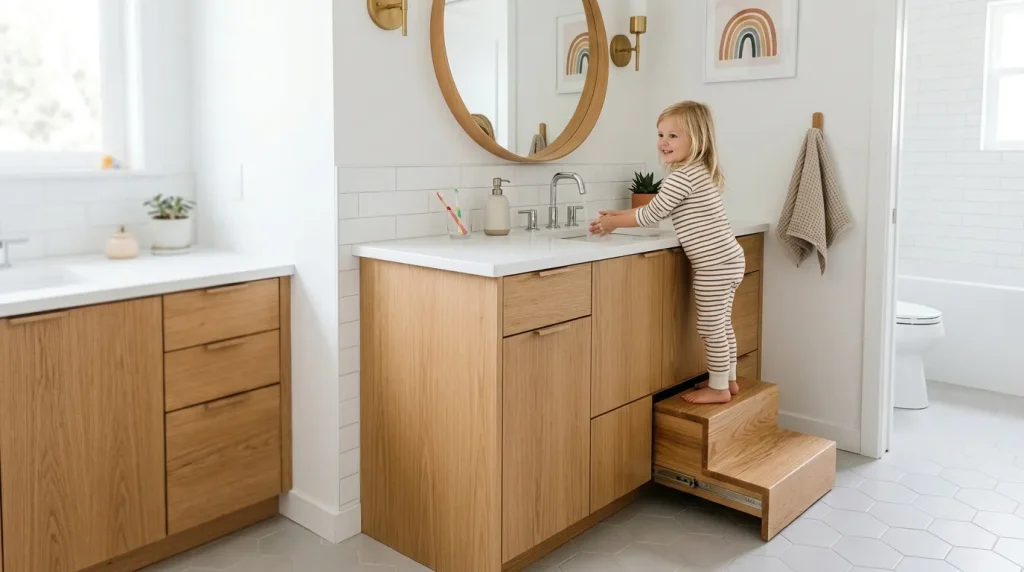
A built-in pull-out step stool is one of those details that seems small until you experience a bathroom that has one — and then it becomes impossible to imagine designing a children’s bathroom without it. The problem with freestanding step stools is that they drift, tip, take up floor space, and get tripped over. A drawer-style stool integrated into the vanity cabinet base solves every one of those problems simultaneously. It slides out when needed, tucks away when not, and maintains the clean, uncluttered look of a well-designed bathroom without sacrificing the accessibility that young children need to use the sink independently.
The design integration is what makes this idea truly stand out. When the step stool is built into the same cabinet as the vanity, finished in the same material and painted or stained to match, it disappears completely when closed — there is no visual interruption to the clean cabinet line. Most carpentry shops or kitchen cabinet makers can add this feature relatively easily to a new or existing vanity unit, making it more accessible than many parents initially assume. In my experience, this is one of the most appreciated features in a well-thought-out children’s bathroom — parents consistently mention it as a detail they wish they’d included from the very start.
3.Rainbow Shower Curtain
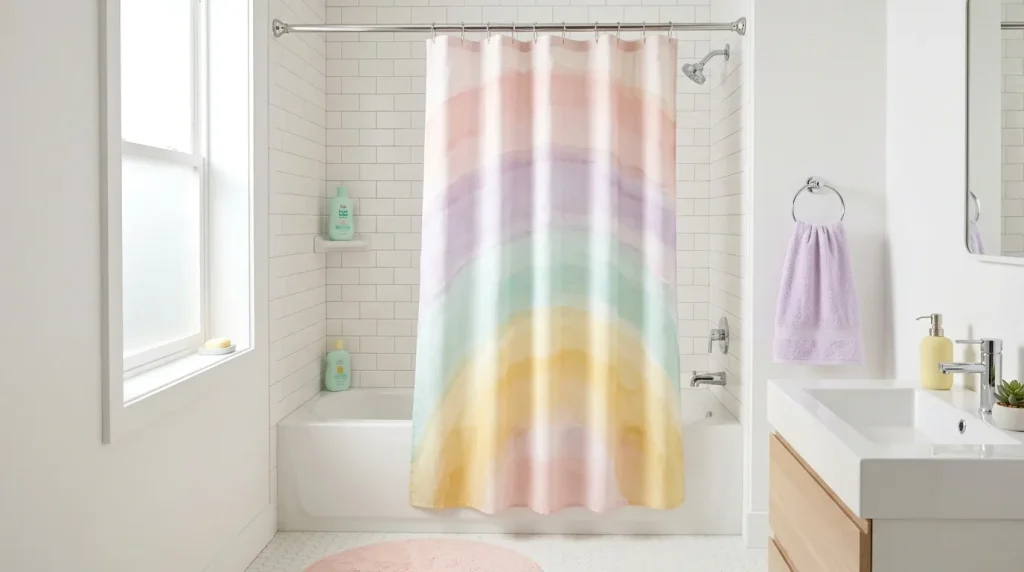
The shower curtain is the single largest piece of textile in most bathrooms, which means it has more influence over the room’s color story and overall mood than almost any other individual element. Choosing a soft watercolor rainbow design in muted pastel tones — blush pink, pale lavender, soft mint, warm butter yellow — creates a bathroom that feels cheerful, colorful, and genuinely beautiful rather than loud or overwhelming. The watercolor treatment softens what could otherwise be a very bold graphic choice, giving the design an artistic, hand-painted quality that reads as considered rather than childish, and that parents can appreciate just as much as children do.
Practically, the shower curtain sets the palette for everything else in the bathroom. Once you have your curtain, choosing towels, bath mats, soap dispensers, and accessories becomes straightforward — simply pull one or two colors from the curtain and repeat them in smaller doses throughout the room. This is the principle that interior designers call the anchor-and-echo approach, and it works consistently well in smaller spaces like bathrooms where the options for introducing color and pattern are limited.
4.Cloud Ceiling Mural
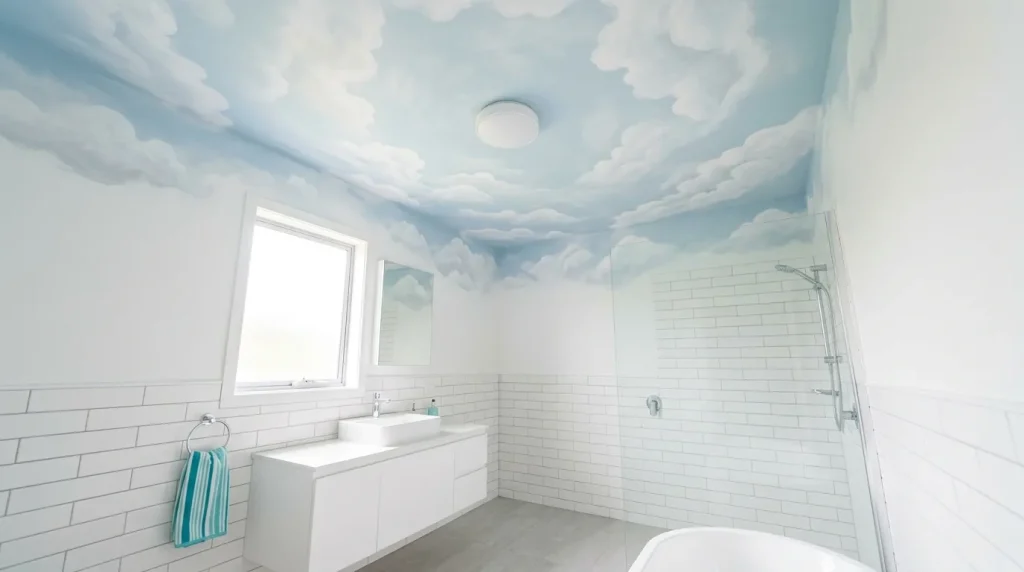
The bathroom ceiling is a surface that most design plans completely forget — and in a children’s bathroom, that’s an enormous missed opportunity. Children spend real time looking up at the ceiling during bath time, which makes it the most consistently viewed surface in the entire room from their perspective. A soft, hand-painted sky mural with fluffy white clouds turns that upward view into a genuinely magical experience — calming, imaginative, and beautiful in a way that a plain white ceiling simply isn’t. The act of looking up at drifting clouds has a naturally soothing quality that supports the winding-down purpose of an evening bath.
The execution is more approachable than most parents initially assume. Using a pale sky blue ceiling paint as the base and adding soft white cloud shapes with a wide brush or sponge creates a convincing mural without requiring any artistic training. The imperfect, organic shapes of clouds mean that any variations in technique actually improve the result, giving the mural a handcrafted, authentic quality. A small addition of very pale grey shading at the base of some clouds adds depth and dimension that makes the painting feel more real.
5.Dinosaur Wallpaper Accent
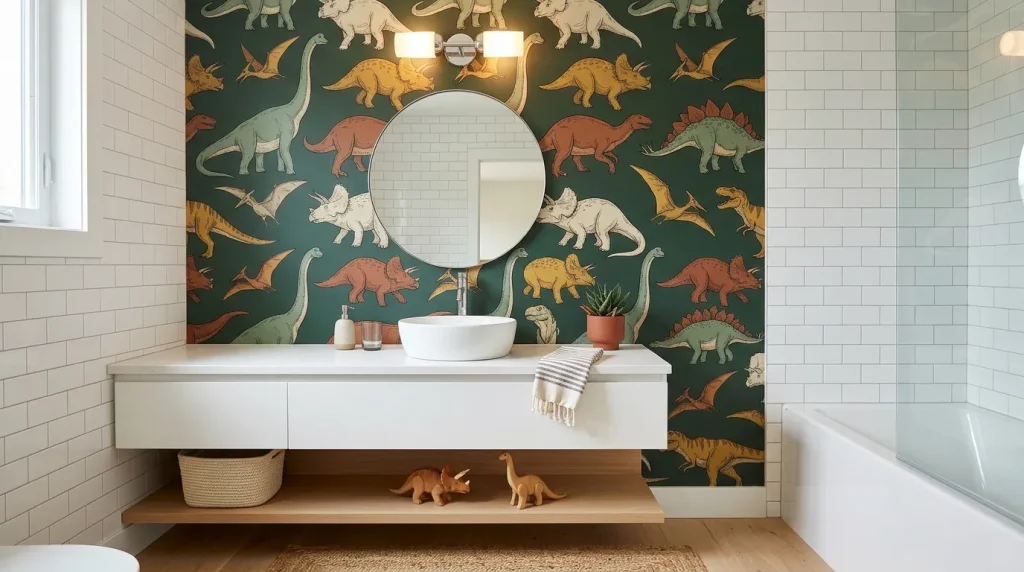
Accent wall wallpaper in a children’s bathroom is one of the highest-impact design moves you can make for the least structural commitment, especially when the print is chosen with an eye toward illustration quality rather than simple cartoon playfulness. A dinosaur wallpaper in sage, rust, and cream on a deep forest green background reads as genuinely beautiful interior design — the kind of thing that appears in design magazines rather than just kids’ stores — while still being exactly the kind of thing an eight-year-old will think is the coolest wall they’ve ever seen.
Limiting the wallpaper to a single accent wall is the key design decision that prevents the room from feeling visually overwhelming. The remaining three walls stay in a clean white or soft neutral tile or paint, which allows the printed wall to breathe and be appreciated as a feature rather than a decoration covering every surface. The vanity wall is typically the best choice for the accent because it’s the first thing you see when entering the room, creating an immediate impression.
6.Chalkboard Paint Wall Panel
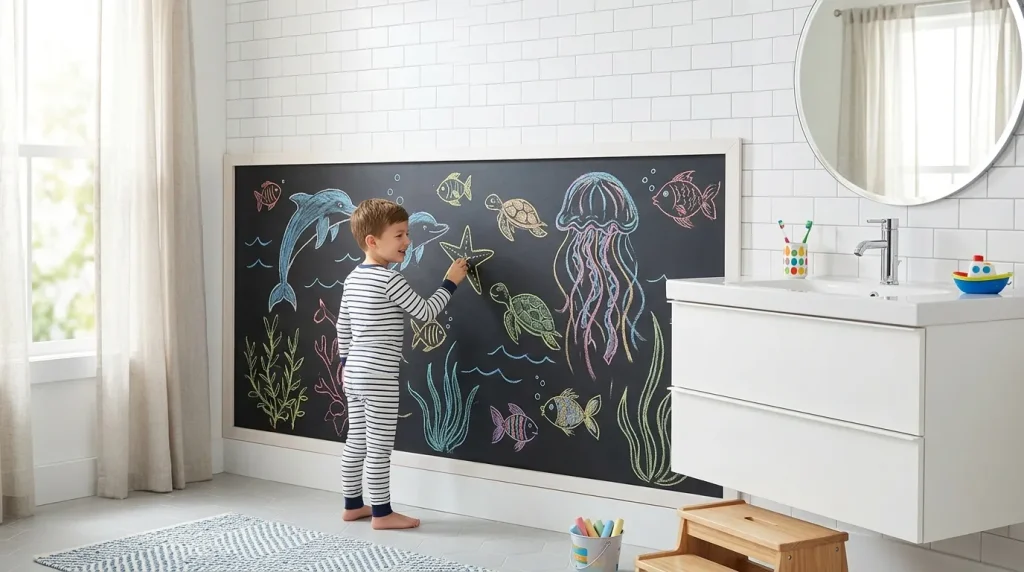
A chalkboard panel in a children’s bathroom is one of those ideas that parents tend to hesitate over and then immediately love once installed. The hesitation is understandable — chalk and bathrooms don’t immediately sound like a natural pairing — but in practice, the chalkboard becomes one of the most-used and most-loved features in the room. Children draw on it before and after bath time, during teeth brushing, and whenever they pass by. The drawings change constantly, which means the bathroom has a rotating gallery of the child’s creativity on its walls — something no purchased artwork can replicate. The bathroom becomes more personal, more alive, and more genuinely theirs.
Framing the chalkboard area is the detail that transforms a painted panel into a designed feature. A simple frame of thin white painted wooden trim around the panel gives it the look of a considered architectural element rather than an afterthought, and clearly defines the area where drawing is welcomed without creating ambiguity about what surfaces are acceptable. Keeping the chalkboard on the lower half of the wall — ending at approximately 120 centimeters from the floor — keeps it accessible to children and out of the direct splash zone of the sink and bathtub.
7.Animal Print Bath Mat
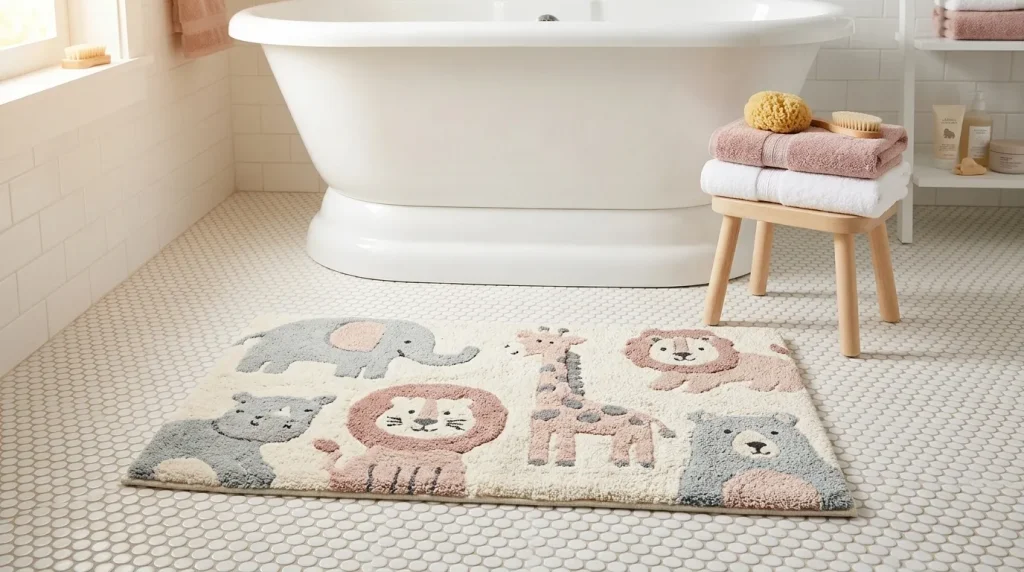
The bath mat sits at the intersection of function and design in a way that few other bathroom accessories do — it has to be safe, absorbent, soft underfoot, and visually pleasant, all at once. In a children’s bathroom, adding an animal or character print in a palette that complements the existing tile and wall color gives the mat a decorative role as well as a purely functional one. A plush mat with a friendly animal design in soft grey, cream, and pale blush tones hits the balance between genuinely fun for children and visually appealing to the adults who also use the space, which is the design challenge that every good children’s bathroom idea needs to solve.
The practical advantages of prioritizing bath mat quality in a children’s bathroom are significant. Young children step out of the bath onto wet feet and tile floors, which creates a genuine slip risk that a quality non-slip bath mat directly addresses. Choosing a mat with a natural rubber or suction-cup backing keeps it in place even during energetic post-bath movement, while a deep-pile or tufted surface absorbs moisture quickly and feels genuinely comfortable underfoot.
To make the room feel even more polished and cohesive, many families also pair playful bathroom décor with inspiration from The Best Unique Kitchen Lighting Ideas for Every Style, especially when looking for creative fixture styles that bring warmth and personality into modern interiors. Machine washability is non-negotiable in a children’s bathroom — choose a mat with clear wash instructions and a construction that maintains its shape and softness through regular laundering, because it will need it.
8.Foam Puzzle Floor Mat
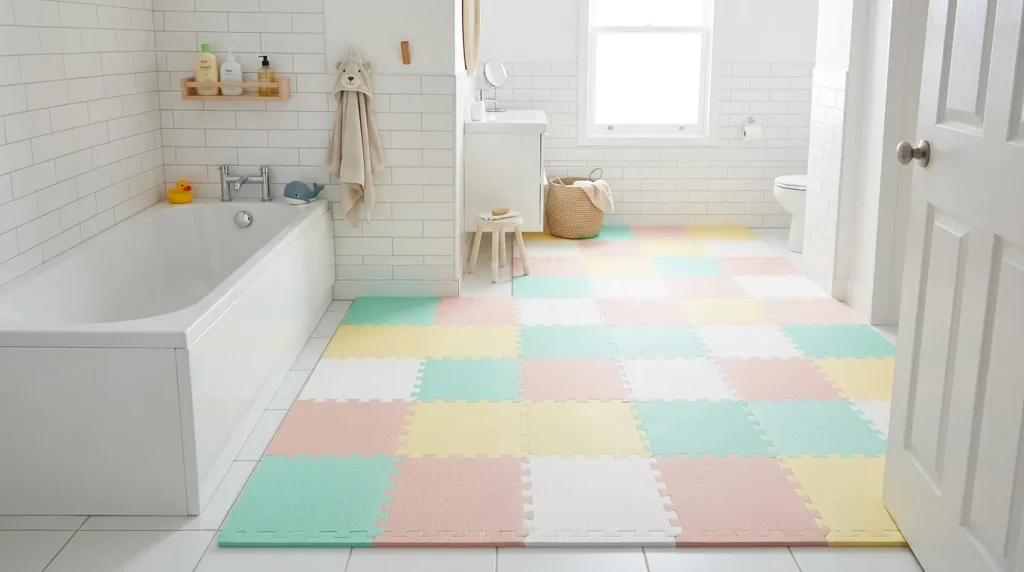
Foam puzzle floor mats are a children’s bathroom staple that gets overlooked in favour of more visually striking ideas — but their practical contribution to a young child’s daily comfort is genuinely significant. Cold tile floors are uncomfortable and even unsafe for small bare feet stepping out of a warm bath, and foam mats provide a cushioned, warm, and non-slip surface that makes the transition from tub to floor safe and pleasant.
The modularity of foam puzzle mats is their greatest practical advantage. Individual tiles can be replaced when one becomes damaged or stained, which extends the life of the overall set significantly and makes the investment genuinely worthwhile over several years of children’s bathroom use. They can be lifted for deep cleaning beneath them, repositioned to fit different bathroom layouts, and added to or reduced as the bathroom’s use changes. For parents renovating a shared bathroom or setting up a first children’s space on a tight timeline, a well-chosen foam mat set can provide immediate visual improvement and real functional benefit while longer-term, permanent design elements are planned and installed.
9.Jungle Leaf Wall Decals
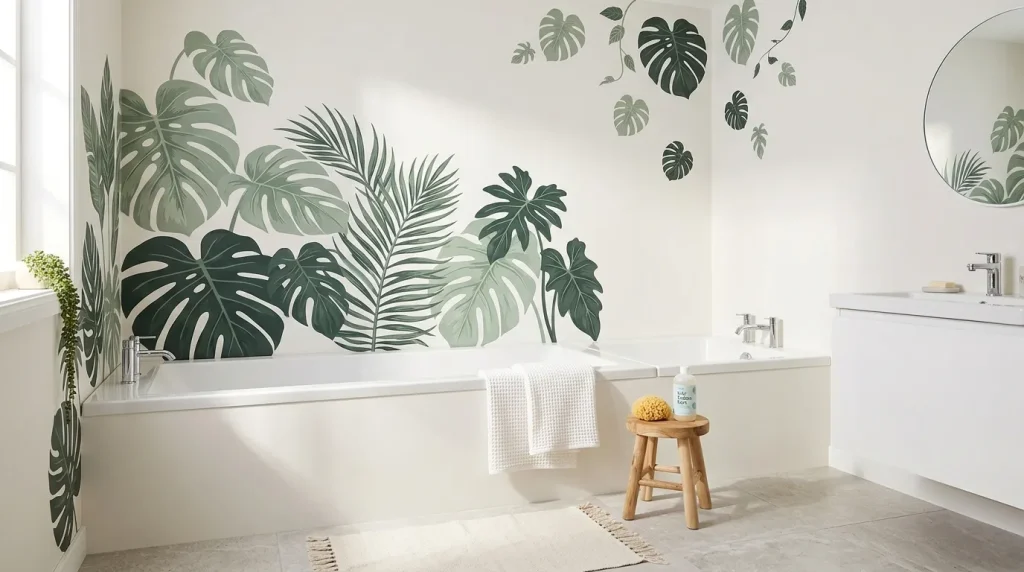
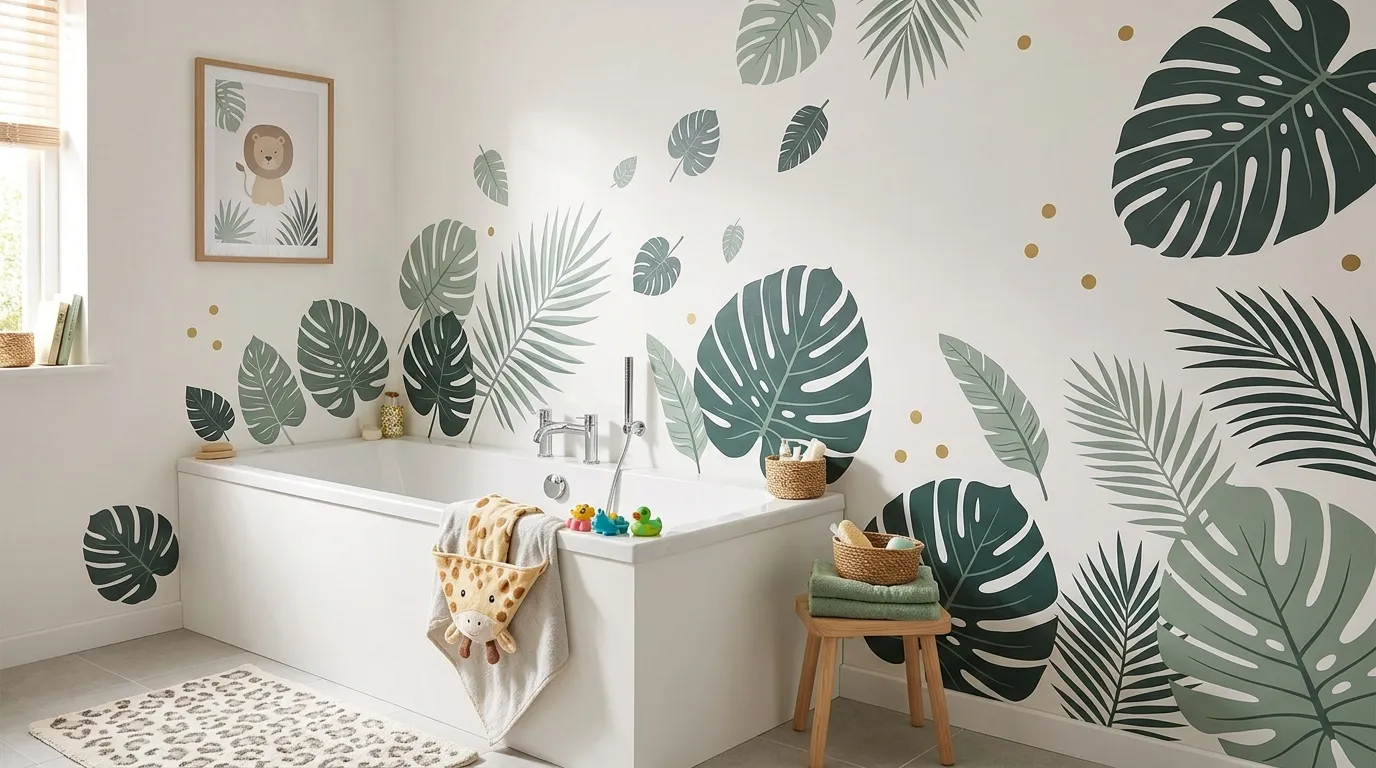
Jungle leaf wall decals are one of the most visually dramatic and practically risk-free updates available for a children’s bathroom, particularly for renters or anyone unwilling to commit to permanent wallpaper or paint. Large-scale tropical leaf designs in muted sage, olive, and deep forest green create an immersive botanical atmosphere that feels genuinely contemporary — inspired by the biophilic design trend that has dominated interior design over the past several years — while remaining completely removable and repositionable. The organic shapes of overlapping tropical leaves contrast beautifully with the hard, geometric surfaces of bathroom tile and rectangular fixtures, introducing a natural softness that transforms the room’s character entirely.
Placement strategy is what makes decals look intentional rather than applied at random. Positioning the largest leaf shapes at the mid-height of the wall beside the bathtub or behind the door, then allowing smaller shapes to trail upward toward the ceiling and outward along the wall, creates the impression of a natural growing pattern rather than a sticker arrangement. Varying the orientation — some leaves angled up, some drooping slightly, some overlapping — reinforces the organic quality. Choosing a decal set that includes leaves in two or three green tones rather than a single flat color adds depth and dimension that makes the design look significantly more sophisticated and considered than a single-tone application.
CONCLUSION:
A thoughtfully designed bathroom can genuinely change how a child feels about everyday routines — and that’s worth every creative decision you make along the way. These children’s bathroom ideas prove that you don’t need a large budget or a full renovation to create a space that is joyful, functional, and beautiful. I’ve seen how even one or two of these changes can completely shift the energy of a bathroom, making it feel designed with real care and love. Save this post on Pinterest, share it with a fellow parent who’s redecorating, and start with one idea that excites you. Your child’s dream bathroom is closer than you think.
Elira Montclair
Elira writes about timeless home decor, kitchen styling, and practical interior ideas. Her work blends warm, inviting aesthetics with simple decorating tips that make everyday spaces feel beautiful and comfortable.